Finding a dependable Rubber Plastic supplier in 2026 takes more than comparing prices or browsing polished product pages. Buyers need to know whether a supplier can repeatedly deliver the right material, dimensions, and performance under real operating conditions. A rubber seal may look correct but fail after months of heat exposure. A plastic component may meet a drawing yet warp during assembly. Details matter.
Start with a clear specification. Include the material grade, hardness range, color, tolerances, expected order volume, and conditions such as temperature, moisture, or chemical contact. Then ask suppliers for relevant technical data, inspection records, sample parts, and an explanation of how they control production changes. Ask for evidence. A responsive sales contact is useful, but it cannot replace consistent quality checks or traceable documentation.
Supplier checks should also cover practical realities: production capacity, lead times, backup plans, packaging, and communication when a batch has a defect. Video calls or site visits can help you understand equipment and workflow, though neither guarantees future performance. Test samples against your own requirements before approving larger orders. Keep the evaluation proportional to the part’s importance and the cost of failure. Not every buyer needs an elaborate audit; sometimes a simple checklist catches more than a glossy presentation. Be willing to revise your assumptions. Reliability is demonstrated over time, through clear records and honest answers—not promised in a brochure.
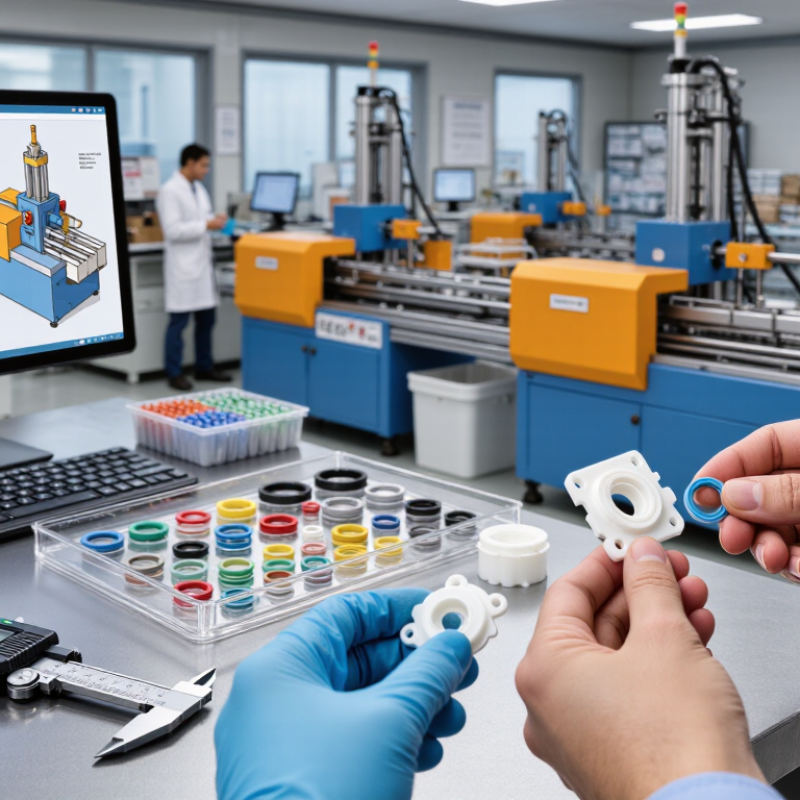
Before requesting quotations, describe the material and its working conditions. For rubber, specify the elastomer, hardness, and exposure to oils, ozone, or heat. For plastics, identify the resin, additives, and recycled-content expectations. Small details matter. A gasket beside hot machinery needs different properties from a flexible outdoor cover.
Translate each use into measurable tests: operating temperature, tensile strength, compression set, impact resistance, and dimensional tolerance. PlasticsEurope reported global plastics production of 413.8 million tonnes in 2023 in Plastics—The Fast Facts 2024. That scale makes a generic label like “industrial grade” inadequate. Ask for the exact grade, current technical data sheet, and test methods. OECD’s Global Plastics Outlook reported that only 9% of plastic waste was recycled in 2019; recycled-content claims therefore deserve clear documentation and traceability. That is not enough.
Set compliance requirements by product use and destination market. Request applicable declarations, safety data, batch identification, and test records before approving samples. For food-contact or medical applications, define the required jurisdictional rules and migration or biocompatibility tests with a qualified specialist. Compare samples under realistic conditions, not just on a polished datasheet. A small mismatch in hardness can change sealing force; I would also recheck tolerances after production tooling is set. Even a careful specification can miss something. Include an approval process for material or process changes, and retain the tested sample as a reference.
Use these examples to frame a specification and supplier evaluation. Property ranges are indicative, vary by grade and test method, and should be confirmed against the selected material’s technical data sheet and your application requirements.
| Material or Requirement | Define the Application | Performance Criteria to Specify | Compliance and Documentation | Supplier Evidence and Verification |
|---|---|---|---|---|
| EPDM rubber | Suitable to evaluate for outdoor weathering, ozone exposure, and hot-water or steam service; generally not selected for petroleum-oil exposure without specific validation. | Specify the operating temperature, media, hardness (Shore A), tensile strength, elongation, compression set, and ozone/weathering requirements. Many grades are used across approximately −40 to +120°C; confirm the grade-specific limit. | Identify any applicable drinking-water, food-contact, or other market-specific requirements. Request the exact compound formulation designation and supporting declarations where required. | Request a current technical data sheet, lot-specific certificate of analysis, and test results for the agreed properties. Validate with samples under the actual media, temperature, and exposure conditions. |
| NBR rubber | Commonly considered for seals exposed to oils and fuels; suitability depends on the fluid composition, temperature, and acrylonitrile content of the grade. | Specify fluid compatibility, temperature range, hardness, tensile strength, elongation, and compression set. Many grades are used around −30 to +100°C, but formulation and exposure can change performance. | State restrictions on substances and any required market or end-use declarations. Request material identification and traceability for the supplied compound. | Ask for documented oil-swell or fluid-compatibility data using a named test fluid and test conditions. Confirm dimensions and sealing performance on production-representative parts. |
| Silicone rubber | Often evaluated for wide-temperature applications and electrical insulation; specify whether the part requires low-temperature flexibility, outdoor resistance, or food-contact suitability. | Define temperature exposure, hardness, tensile strength, tear strength, compression set, color, and any electrical properties. Some grades operate over a broad range, commonly around −50 to +200°C; confirm continuous-use limits for the selected grade. | For food-contact uses, identify the applicable jurisdiction and product conditions. A general material description alone does not establish compliance for a finished article. | Request grade-specific technical data, applicable declarations, batch identification, and test reports. Assess odor, extractables, and finished-part performance where relevant to the application. |
| FKM rubber | Consider for demanding heat and chemical exposure, especially where the specific fluid compatibility is established; not all grades suit every chemical or low-temperature condition. | Specify the exact media, temperature profile, hardness, compression set, and swelling limits. Many grades are used around −20 to +200°C, with limits varying by formulation and exposure. | Document restricted-substance requirements and end-use approvals, if applicable. Require clear identification of the supplied grade rather than relying only on a generic polymer name. | Request compatibility data for the actual fluid and temperature, lot traceability, and a certificate of analysis against agreed limits. Test seals in the intended assembly where failure risk is significant. |
| HDPE plastic | Commonly considered for chemical containers, pipes, and other applications requiring a relatively low-density polyethylene; confirm stress, temperature, and chemical conditions. | Specify grade, density, melt-flow rate, tensile properties, impact requirements, dimensions, and service conditions. Typical HDPE density is approximately 0.94–0.97 g/cm³; mechanical properties depend on grade and test method. | For food contact or regulated uses, specify the target market, applicable rules, and intended conditions of use. Request declarations for the exact grade and, where needed, the finished article. | Request a technical data sheet, batch certificate, resin identification, and process-control records. Verify dimensions, impact performance, and chemical resistance using defined test methods. |
| Polypropylene (PP) | Often evaluated for lightweight molded parts and chemical-resistant components; distinguish homopolymer and copolymer grades because impact and stiffness differ. | Specify polymer type, melt-flow rate, stiffness, impact strength, heat exposure, shrinkage, and dimensional tolerances. Typical PP density is approximately 0.90–0.91 g/cm³, subject to grade and additives. | Identify any applicable food-contact, restricted-substance, or product-specific requirements. Confirm that declarations match the exact grade, color, and additive package. | Request grade-specific data and batch traceability. Approve molded samples against fit, function, appearance, and dimensional criteria before production release. |
| PA 6 (nylon 6) | Consider for load-bearing or wear-related components, while accounting for moisture exposure and its effect on dimensions and mechanical behavior. | Specify grade, reinforcement, moisture conditioning, strength, impact, wear, and dimensional tolerances. State the test conditioning method because polyamide properties change with absorbed moisture. | Define applicable substance restrictions and any end-use approvals. Require disclosure of reinforcement, colorants, and other additives relevant to the specification. | Request technical data for the exact conditioned grade, batch documentation, and dimensional inspection results. Evaluate parts after representative moisture and temperature conditioning. |
| PTFE plastic | Often considered for low-friction or chemically demanding components; account for creep under load and verify suitability for wear applications. | Specify temperature, chemical exposure, load, friction, wear, dimensions, and whether a filled grade is required. Many PTFE grades are rated for continuous service near 260°C, but design and grade limits must be verified. | For regulated uses, define the applicable market and conditions of use. Request documentation for the specific grade and any fillers or processing aids. | Request grade identification, property data, and dimensional inspection records. Check creep or wear under representative load, temperature, and operating duration. |
| Supplier quality system and traceability | Define production location, process capability, subcontracted operations, lot size, and continuity requirements before qualification. | Agree on acceptance criteria, sampling plan, change-control process, nonconformance handling, and measurable critical-to-quality characteristics. | Request current quality-system certification where relevant, while recognizing that certification does not by itself certify a product or guarantee its suitability. Specify applicable regulatory declarations separately. | Review sample inspection reports, lot traceability, corrective-action examples, audit findings, and the supplier’s process for notifying customers of material or manufacturing changes. |