
7 Tips for Buying Large Outdoor Ceramic Flower Pots

Large outdoor planters can transform a bare patio into a welcoming garden. But a pot that looks perfect under showroom lights may crack after one winter or leave roots sitting in water. Choosing ceramic flower pots large outdoor spaces can use safely means weighing more than color and shape.

There is no widely used industry report that isolates sales or failure rates for large outdoor ceramic pots. The USDA’s 2023 Plant Hardiness Zone Map offers a useful, evidence-based starting point: it assigns zones using 1991–2020 average annual extreme minimum temperatures. That local cold-weather context matters when comparing glazed and unglazed ceramics, checking frost resistance, and deciding whether pots need winter protection. The National Gardening Association’s National Gardening Survey also tracks gardening and container-growing trends, though it does not provide a specific durability ranking for ceramic planters.

Horticulturist Dr. Linda Chalker-Scott of Washington State University Extension has written about drainage in container planting. A practical distillation of her guidance is: “Good drainage depends on the container and growing medium—not a layer of gravel.” Small detail. Big difference. A blocked drainage hole can keep a large planter’s soil wet long after rain has stopped.

This guide shares seven practical tips for choosing size, weight, drainage, glaze, and weather resistance. It also points out a trade-off buyers sometimes overlook: thick ceramic can feel reassuringly sturdy, yet become difficult to move once filled. Measure the doorway first. Then picture the pot in your garden, through a wet spring and a freezing night.
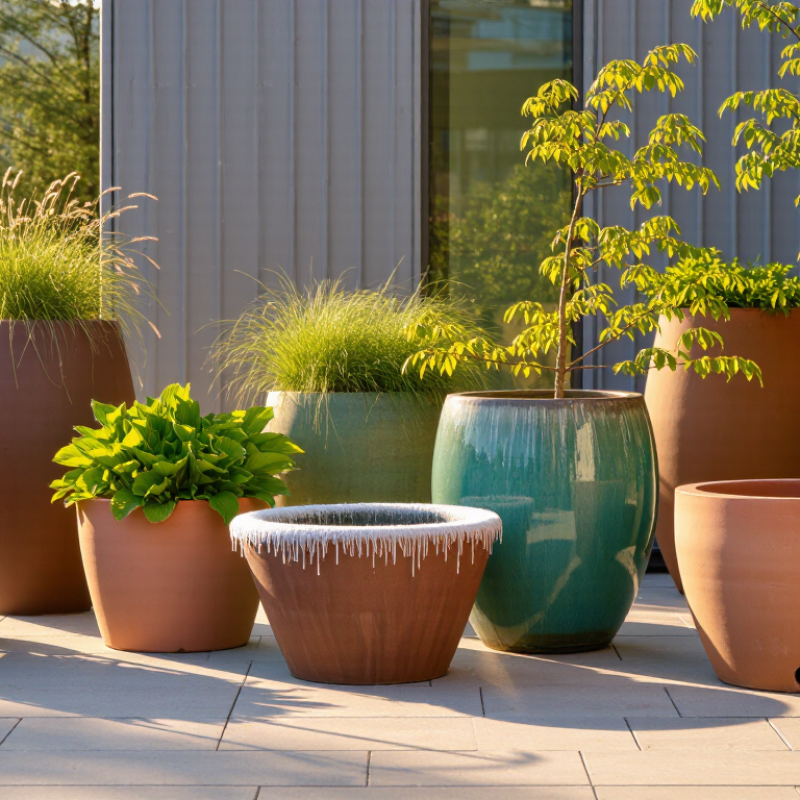
7 Tips for Buying Large Outdoor Ceramic Flower Pots

Size the Pot for Root Growth: Leave 2–4 Inches Beyond the Root Ball

Measure the root ball before choosing a large ceramic pot. Leave 2–4 inches of space around it, not just beneath it. That gives young roots room to spread without surrounding them with a deep, soggy mass of potting mix. For example, a root ball 12 inches wide needs roughly 16–20 inches of interior pot width. Check the pot’s inside dimensions; thick ceramic walls can make the opening narrower than its listed size. Small detail. Big difference.

University of Maryland Extension’s container-gardening guidance stresses drainage and choosing a container suited to the plant’s mature size. Keep that in mind when judging the extra space: a pot that is far too large can stay wet longer around a small root system. Use drainage holes, and don’t let the pot sit in standing water.

The USDA’s 2023 Plant Hardiness Zone Map uses 30-year average annual extreme minimum temperatures from 1991–2020. That dataset does not determine pot size, but it helps assess winter exposure for outdoor ceramic containers. I’ve found the tempting part is buying one oversized pot “for later”; the less satisfying truth is that roots need suitable moisture now, not just room someday.

Measure Rim, Base, and Capacity to Compare Pots Accurately

Before comparing large outdoor ceramic pots, measure the rim across its inner opening. This tells you whether a root ball or nursery pot will fit, while the outside rim measurement helps check clearance beside walls or railings. Use a tape measure across the widest points, and note inches or centimeters consistently. Small details matter. A thick, rolled rim can make the opening narrower than the pot’s listed diameter.

Measure the base at its widest footprint, not halfway down the body. A tapered pot may look broad but rest on a much smaller ring, which matters on a narrow stand or uneven patio. Then compare usable capacity, preferably in liters or gallons, rather than relying on exterior height and width alone. Check internal dimensions if capacity is missing; a narrow bottom holds less soil than a straight-sided pot with the same rim. Not always obvious. I have found measurements can still be imperfect when pot walls curve sharply, so treat calculated volume as an estimate. Record rim, base, and capacity side by side to compare pots more fairly.

Compare Large Outdoor Ceramic Pot Capacity

Estimated capacity for three example pot sizes. Measurements are interior rim diameter × base diameter × height; volumes assume a straight-sided frustum and are rounded to the nearest liter.

Example A: 40 × 28 × 36 cm (≈33 L) · Example B: 50 × 35 × 45 cm (≈65 L) · Example C: 60 × 42 × 54 cm (≈111 L). Actual usable capacity varies with wall thickness, shape, and drainage features. Measure the rim, base, and height before comparing pots.

Check Drainage: Target 10–20% Air-Filled Porosity in Container Media

For a large outdoor ceramic pot, drainage starts with the planting mix, not the glaze. Look for an unobstructed drainage hole and a stable, coarse-textured container medium. A useful target is 10–20% air-filled porosity by volume after excess water drains. This leaves air around roots between waterings instead of keeping them in saturated pockets. Small detail. A hole can still clog against a flat patio or inside a saucer.

When comparing mixes, ask for air-porosity or water-retention data; appearance alone cannot confirm the ratio. Garden soil often compacts in a deep pot, while fine particles can settle and restrict airflow. A mesh screen may help keep mix from washing out, but avoid packing it tightly over the hole. Raise the pot slightly on feet so water can escape beneath it. Too wet? Check the lowest few inches, where dampness may linger after the surface looks dry.

An imperfect shortcut is judging drainage by how quickly water leaves the hole. Fast flow can mean water is channeling around dry mix, not wetting roots evenly. Water slowly until it runs out, then check the mix the next day. Ceramic walls may reduce side evaporation, so aeration matters during cool, rainy spells. If the pot stays heavy and soggy, reconsider the mix before adding more water.

Assess Freeze Risk: Water Expands by About 9% When It Freezes

Water trapped inside a large ceramic planter can become a quiet winter hazard. The U.S. Geological Survey’s Water Science School explains that water expands by about 9% as it freezes. In a saturated pot, that extra volume presses against the clay’s pores and tiny flaws. Repeated freezing and thawing may lead to hairline cracks, flaking, or a split wall. It is not only the coldest night that matters. Wet soil, blocked drainage, and a slow thaw can keep water inside the pot longer.

Check the maker’s freeze-resistance guidance, but treat “thick” as no guarantee. ASTM C1026 describes freeze-thaw testing for ceramic and glass tile; it is useful technical context, though it is not a flower-pot rating. Look for a clear drainage hole, and raise the planter slightly so water can escape beneath it. Before a freeze, empty standing water and consider moving the pot under cover. A small saucer can hold more water than expected. I would inspect the base, too; it is easy to miss a damp ring there. If the pot is already saturated, moving it gently is wiser than dragging it across frozen ground.

Compare Water Absorption: ≤0.5% Is the Porcelain-Tile Benchmark in ISO 13006

When comparing large outdoor ceramic pots, ask what the absorption figure describes: the fired body, the glaze, or a finished sample. This matters. ISO 13006 uses water absorption to classify ceramic tiles; its BIa group sets a limit of ≤0.5%. That is a useful porcelain-tile benchmark, not automatic proof that a flowerpot meets the standard or will survive every winter.

Look for a test report that identifies the product and method, rather than relying only on “porcelain” in a sales description. Low absorption can mean less water enters the ceramic body, reducing one source of freeze-thaw stress. But shape, firing quality, glaze defects, drainage, and trapped water also affect durability. A broad pot with a blocked drainage hole can still hold water after rain.

Inspect the base and rim for hairline cracks, uneven glaze, or rough, exposed areas. Ask whether the pot was tested as a finished item, especially if its interior is glazed. A small absorption number is reassuring, but it is not the whole story. I would still raise the pot slightly on feet and clear its drainage hole before cold weather. Practical, perhaps not perfect.

7 Tips for Buying Large Outdoor Ceramic Flower Pots - Compare Water Absorption: ≤0.5% Is the Porcelain-Tile Benchmark in ISO 13006

Tip What to Check Useful Data or Comparison Why It Matters
1. Compare water absorption carefully Ask for a measured absorption value and the test method. Check whether the figure applies to the pot body, a tile, or another sample. ISO 13006 classifies ceramic tiles by water absorption. Its BIa category is ≤0.5%; this is a porcelain-tile benchmark, not a general certification threshold for flower pots. Lower absorption can mean less water enters the ceramic body, but the tile classification alone does not establish a pot’s outdoor or frost performance.
2. Confirm outdoor and freeze-thaw suitability Look for explicit outdoor-use information and ask how the pot was tested for the expected climate. Freeze-thaw damage risk depends on factors including water uptake, drainage, clay body, and exposure. A low absorption figure by itself is not a complete guarantee. A pot that stays saturated and freezes may be more vulnerable to cracking or surface damage.
3. Check drainage and water escape Inspect the base for drainage holes and make sure the design allows water to flow out when the pot is placed on its intended surface. Compare the number, position, and openness of the holes; confirm whether a saucer or feet could block them. Good drainage helps prevent prolonged waterlogging around roots and reduces standing water inside the pot.
4. Match internal size to the plant Compare internal diameter and usable depth, rather than relying only on the outside dimensions. For a rough cylindrical estimate, volume in litres ≈ 3.14 × radius² × internal height in cm ÷ 1,000. Tapered shapes hold less than this estimate. Usable volume and root-room affect how much growing medium the pot can hold and how often it may need watering.
5. Plan for the filled weight Check the empty pot weight and consider the weight of the growing medium, plant, and retained water. One litre of water has a mass of approximately 1 kg. The finished pot can be substantially heavier than the empty vessel. Weight affects placement, moving, balcony or deck loading, and the risk of tipping in exposed locations.
6. Assess stability and base design Compare the base width with the pot height and check that the base sits evenly on a flat surface. A wider, level base generally offers a more stable footprint than a narrow base on a tall pot; assess the actual shape and placement conditions. Stability is particularly important for tall plants and locations exposed to wind or accidental knocks.
7. Inspect finish, rim, and care details Look for chips, cracks, uneven glazing, and a sound rim. Ask whether the finish is intended for continuous outdoor exposure. Compare care instructions and any stated limits for sunlight, temperature, cleaning products, or winter storage. The finish and exposed edges can affect appearance and durability; clear care guidance helps set realistic expectations.

Note: ISO 13006 covers ceramic tiles. Use its ≤0.5% BIa value as a tile comparison benchmark only; verify outdoor performance for the specific flower pot separately.

Shopping cart