
China’s glassware industry has become a major sourcing base for restaurants, retailers, hotels, and wine brands. This guide examines China’s top 10 Red Wine Glasses manufacturers through practical and verifiable criteria. These criteria include production capacity, material quality, export experience, customization, testing procedures, and delivery performance.
The International Organisation of Vine and Wine reported global wine consumption at approximately 214 million hectolitres in 2023. That volume supports continued demand for suitable wine-service products, even while the wine market faces economic pressure. Grand View Research also identifies growing interest in premium glass tableware, hospitality upgrades, and durable household products. These trends help explain why Chinese manufacturers attract international buyers.
A good red wine glass is not judged by appearance alone. Its bowl should support aroma development, while its rim needs a clean, comfortable finish. Buyers should also examine lead-free crystal claims, stem strength, thermal-shock resistance, dishwasher performance, and packaging protection. One cracked glass can damage an entire retail shipment. Small details matter.
This article compares manufacturers using available company information, product evidence, certifications, factory capabilities, and customer-service indicators. Public data is not equally complete for every supplier. That limitation deserves attention. Some rankings may change as factories expand, prices shift, or export records become clearer. Therefore, the list should guide supplier research, not replace factory audits or sample testing.
Readers will find manufacturers suitable for bulk hospitality orders, private-label collections, and customized Red Wine Glasses. The strongest supplier may not be the largest one. Sometimes, consistent quality and honest communication matter more than impressive machinery.
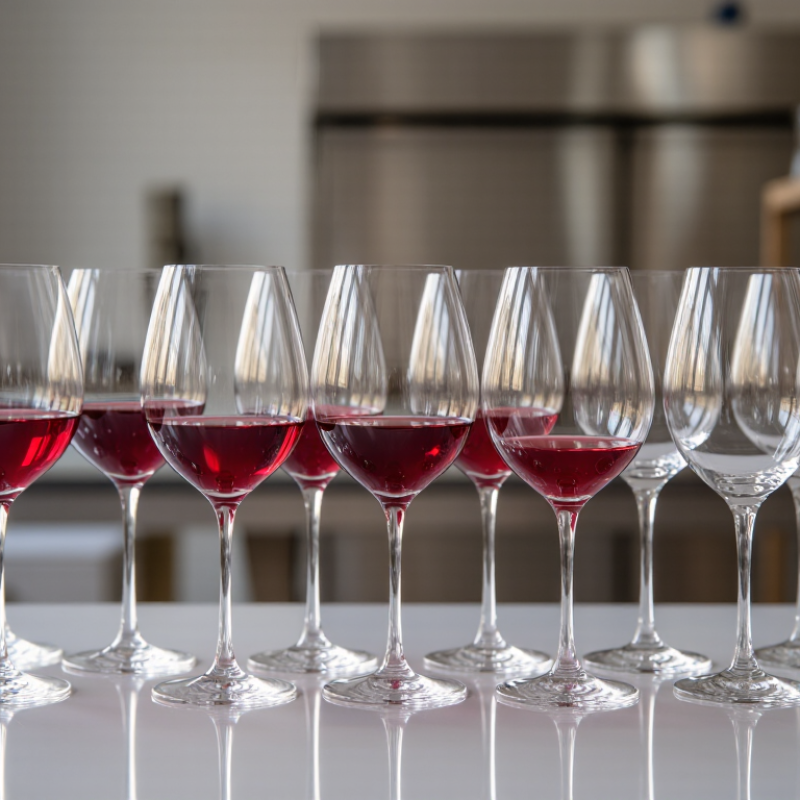
A leading red wine glass manufacturer in China offers more than attractive shapes. It controls raw materials, forming accuracy, annealing, polishing, and final inspection. According to UN Comtrade 2023 data, China exported over US$5 billion in glassware under HS 7013. That scale shows strong production capacity, but not consistent quality. A reliable factory should provide batch records, sample testing, and clear tolerances for rim thickness, bowl volume, and stem alignment.
Professional buyers should also examine food-contact safety and durability. ISO 7086-1 provides testing guidance for glass hollowware used with food. Responsible manufacturers should explain migration testing, thermal-shock performance, and lead-free material controls. Automated inspection can reduce defects, yet manual checking remains valuable around the rim and foot. From practical sourcing experience, a perfect sample sometimes hides unstable mass production. That deserves scrutiny. Sustainability matters too. Energy-efficient furnaces, recycled cullet, low-waste packaging, and measurable shipping damage rates indicate mature management. Grand View Research identifies growing demand for premium glass tableware, but market growth alone cannot prove manufacturing expertise.
Tips: Request three production samples, not one. Compare their weight, clarity, rim smoothness, and balance. Ask for recent inspection reports and factory process videos. Confirm whether customized logos affect dishwasher resistance. Keep one sample from every approved batch for future comparison. Small checks prevent expensive surprises.

China Top 10 Red Wine Glasses Manufacturers?
How China’s Red Wine Glass Manufacturing Industry Is Organized
China’s red wine glass industry is organized around regional production clusters. Large factories usually manage melting, forming, annealing, decoration, and packaging in one location. Smaller workshops often specialize in shaping, polishing, or custom decoration. This structure gives buyers flexible sourcing options, but supplier capabilities can vary sharply.
A typical production line begins with silica sand, soda ash, limestone, and recycled glass. These materials enter a furnace operating above 1,400°C. Automated machines form the bowl, stem, and foot within seconds. Controlled annealing then reduces internal stress and lowers breakage risks. Experienced quality teams inspect rim smoothness, wall thickness, clarity, capacity, and vertical balance.
Details matter.
During factory evaluations, buyers should request batch records, material specifications, and drop-test results. They should also check whether inspection is fully automated or partly manual. Manual inspection can identify surface marks, yet fatigue may cause inconsistent judgments. Automated systems improve speed, but they may miss unusual shaping defects.
Manufacturers generally serve domestic wholesalers, hospitality suppliers, retailers, and overseas importers. Export-oriented facilities often provide carton testing, barcode support, pallet planning, and documentation for destination markets. However, production scale alone does not prove reliability. A factory may have modern equipment but weak process control, delayed communication, or unstable subcontractors. Sample approval, pilot orders, and repeated batch checks remain practical safeguards for professional procurement.
| No. | Industry Dimension | Typical Chinese Manufacturing Profile | Common Commercial Data | Why It Matters to Buyers |
|---|---|---|---|---|
| 1 | Primary Glass Material | Most mass-produced red wine glasses use food-contact soda-lime silicate glass. Premium lines may use strengthened, crystal-style, or lead-free crystal glass. | Lead-free formulations are increasingly specified for tableware intended for international markets. | Material selection affects clarity, weight, durability, cost, and compliance requirements. |
| 2 | Manufacturing Method | The industry is divided between automatic machine-made production and manual or semi-manual production. | Machine-made lines support high repeatability; handmade lines support complex shapes, smaller batches, and decorative work. | The chosen process determines minimum order quantity, unit price, lead time, and consistency. |
| 3 | Product Construction | A standard stemmed wine glass consists of a bowl, stem, and foot. These parts may be formed as one piece or joined during production. | One-piece machine production generally emphasizes productivity; joined construction allows more design flexibility. | Construction affects joint strength, appearance, balance, and breakage risk. |
| 4 | Common Bowl Capacity | Red wine glasses manufactured for hospitality and retail markets commonly use medium-to-large bowl formats. | Typical nominal capacities are approximately 450–750 ml, with larger designs also available for specialist use. | Capacity influences product positioning, carton dimensions, shipping cost, and serving presentation. |
| 5 | Finishing Operations | Finishing may include rim fire-polishing, edge treatment, annealing, grinding, spraying, printing, frosting, and electroplating. | Clear, undecorated products are normally the simplest to scale; decoration adds process steps and inspection points. | Finishing affects mouthfeel, visual quality, scratch resistance, and production cost. |
| 6 | Thermal Processing | Annealing in a controlled lehr is a standard step used to reduce internal stress created during forming and cooling. | Thermal-shock performance depends on glass composition, wall thickness, forming quality, and annealing conditions. | A wine glass should not be described as heat-resistant unless the finished product has been specifically tested for that claim. |
| 7 | Quality-Control Points | Factories commonly inspect dimensions, rim condition, bubbles, stones, cords, inclusions, optical distortion, base stability, and breakage. | Inspection standards are usually agreed through approved samples, defect classifications, and an AQL-based inspection plan. | Clear acceptance criteria reduce disputes over cosmetic and functional defects. |
| 8 | Food-Contact Compliance | Export-oriented production typically evaluates glass composition, heavy-metal migration, coatings, inks, and other food-contact materials. | Relevant frameworks may include China’s GB 4806 food-contact standards, EU Regulation (EC) No. 1935/2004, and applicable destination-market rules. | Compliance must be confirmed for the complete finished product, including decoration and coatings. |
| 9 | Packaging and Logistics | Because stemware is fragile and space-intensive, manufacturers use dividers, molded pulp, foam, inner cartons, master cartons, and pallet protection. | Packaging validation normally includes drop, compression, vibration, and transit-risk assessments appropriate to the shipping route. | Packaging design can materially affect landed cost and damage rates. |
| 10 | Production Organization | China’s supply structure includes glass melting plants, stemware factories, decoration workshops, packaging suppliers, trading companies, and export distributors. | A single order may involve forming, annealing, decoration, inspection, and packing at separate or integrated production sites. | Buyers should identify which processes are performed in-house and which are subcontracted before approving a supplier. |
Note: Commercial capacities and production practices vary by product design, factory equipment, order volume, and destination-market requirements. Compliance claims should be verified through current test reports for the finished product.
The top 10 red wine glass manufacturers in China are best compared through measurable production strengths. Look for factories with stable furnace temperatures, skilled forming teams, and documented quality checks. A reliable supplier should explain its glass composition clearly. Lead-free crystal and soda-lime glass serve different price and performance needs.
Bowl shape matters. A broad bowl can support swirling and aroma release, while a thinner rim improves drinking comfort. Check the stem connection, foot balance, and wall thickness before placing a large order. Good manufacturers usually provide samples, dimensional drawings, and packing tests. Ask for annealing records, visual inspection standards, and breakage data. Small details reveal production discipline.
Export experience also deserves careful review. Strong suppliers can manage carton design, moisture protection, labeling, and shipment schedules. Confirm minimum order quantities, mold fees, replacement policies, and inspection procedures in writing. Some factories present attractive samples but struggle with repeat consistency. That weakness is easy to miss. An independent pre-shipment inspection can reduce surprises, although it adds cost and time.
The leading ten should not be ranked by catalog appearance alone. Evaluate production capacity, customization control, worker training, packaging strength, and communication speed. Request the same test order from several manufacturers. Compare rim smoothness, stem alignment, clarity, and damage rates under identical conditions. A perfect ranking is unrealistic; buyer needs differ by market, budget, and restaurant use. Careful verification remains more dependable than impressive claims.
When comparing China’s red wine glass manufacturers, product quality should be tested beyond appearance. A clear bowl, smooth rim, and stable base are useful starting points. Check the glass thickness around the rim and stem. Uneven thickness can affect balance and drinking comfort. Lead-free crystal glass may offer clarity, but suppliers should provide material reports from recognized laboratories. Ask for carton drop tests, dishwasher testing, and production samples from different batches.
Design requires more than attractive photographs. Measure the bowl diameter, stem height, foot width, and total capacity. A well-shaped red wine glass should allow swirling without frequent spills. The rim should direct wine smoothly, not feel sharp against the lips. Request technical drawings before approving a sample. Small changes in curvature can alter both elegance and durability. A polished sample can mislead. I have seen excellent samples followed by ordinary bulk production.
Production capacity should be checked with records, not confident promises. Review monthly output, molding equipment, inspection procedures, and the number of skilled workers. Ask how the factory handles peak seasons and urgent replacements. Capacity figures should match warehouse space, packaging lines, and shipping history. Independent quality inspections can verify consistency before shipment. Large capacity does not guarantee reliable quality. Smaller workshops may offer closer control, but delivery risks can increase. This trade-off deserves careful questioning.
Comparative benchmark using anonymized supplier profiles. Scores are based on commonly used sourcing criteria: material consistency, design capability, and production scale.
Each category is scored from 0 to 100. Quality considers glass clarity, wall-thickness consistency, finishing, and durability. Design considers mold development, shape customization, and decoration options. Production capacity considers equipment scale, automation, output stability, and order fulfillment capability. The chart is intended as a practical comparison framework rather than a ranking of named companies.
Choosing among China’s top ten red wine glass manufacturers requires more than comparing catalog photos. A reliable supplier should explain its glass composition, production process, and inspection methods in clear English. Ask whether the bowl is machine-made or hand-finished. Request samples with different rim thicknesses, stem lengths, and capacities. A serious factory will record these details. It should also provide food-contact documentation, factory audit records, and recent quality reports. Do not accept vague promises.
During supplier checks, inspect each sample under bright light. Look for cloudy spots, uneven rims, tiny bubbles, and wobbling bases. Fill the glass with water and place it on a flat table. It should remain stable when lightly touched. Measure ten pieces, not one. Small differences often appear only in a larger batch. Confirm carton dividers, drop testing, export experience, minimum order quantity, lead time, and replacement policy. Ask for packing-line photos, but treat them as supporting evidence, not proof. A video call can reveal workflow, though it cannot replace independent inspection.
Pricing deserves careful reading. A low quote may exclude mold fees, protective packaging, or shipping charges. Compare identical specifications in one sheet. Include volume, weight, tolerance, decoration method, and delivery terms. Suppliers that answer quickly are not always precise. I have found that written confirmations prevent costly misunderstandings. Still, even a well-checked supplier can make mistakes. Leave time for pre-shipment inspection and allow for limited breakage. The right Chinese supplier is one whose process remains transparent after the order is placed.
Headquarters
2980 Scott St, Vista, CA 92081
Phone: (760) 734-4177
Fax: (760) 734-4188
Open: 8:00 am – 4:30 pm
Texas
8051 Jetstar Dr #175 Irving, TX 75063
Phone: (972) 915-6888
Fax: (972) 915-6999
Open: 8:00 am – 4:30 pm
Florida
14231 Jetport Loop. #1 Fort Myers, FL 33913
Phone: (239) 225-4020
Fax: (239) 225-4024
Open: 8:00 am – 4:30 pm