
Choosing the right PUR Block Foam manufacturer can shape product quality, production stability, and long-term purchasing costs. Global buyers often compare suppliers by density control, compression performance, cutting accuracy, and delivery capability. Yet these figures rarely tell the whole story. A factory may offer attractive pricing but lack consistent batch records or responsive technical support.
This guide introduces leading PUR Block Foam manufacturers for international purchasing teams. It focuses on practical evidence, including production experience, material testing, quality systems, export readiness, and customer communication. Buyers should review technical data sheets, sample results, and factory audit records before making decisions. A clean production floor matters. So does a well-labeled sample box showing density, dimensions, and test dates.
Details reveal reliability.
Manufacturers serving furniture, bedding, automotive, packaging, and acoustic markets may require different foam characteristics. Flexible foam for seating needs a different balance than foam used for sound absorption or protective packaging. Buyers should confirm raw material sources, allowable tolerances, fire-performance documentation, and shipment protection. Regional compliance requirements also deserve careful review, because certificates may not cover every destination or application.
No ranking can fit every buyer. Supplier information can change, and public claims may remain incomplete. That limitation deserves attention. The most dependable choice usually comes from verified samples, transparent communication, and repeatable test results. By comparing these factors carefully, global buyers can reduce uncertainty and select a PUR Block Foam partner with stronger technical and commercial foundations.
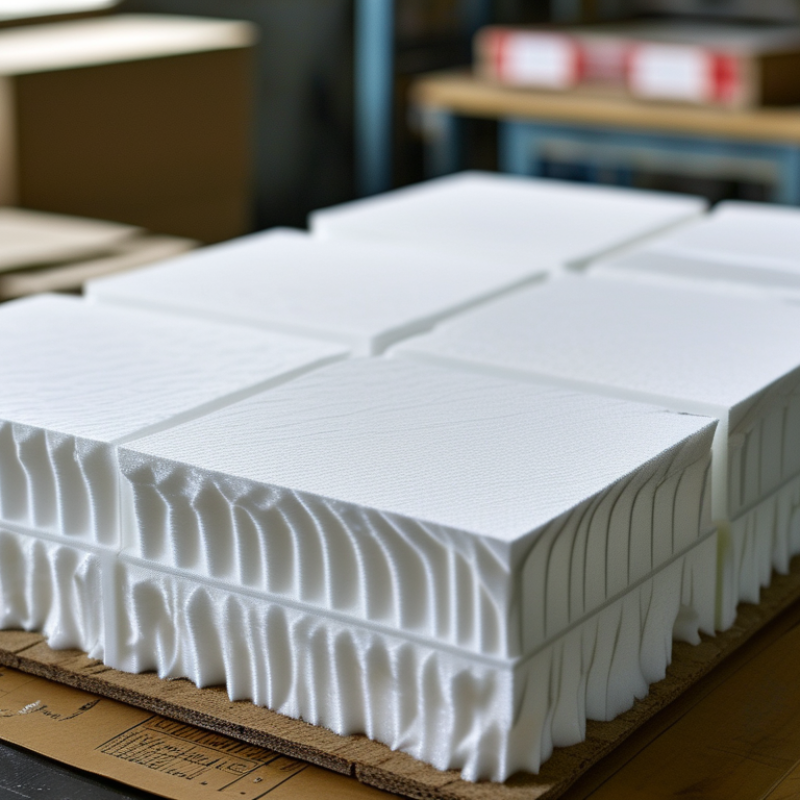
PUR block foam demand is closely tied to furniture, mattresses, transport seating, and insulation. Grand View Research valued the global flexible polyurethane foam market at approximately USD 12.9 billion in 2023. Its forecast indicates about 4.6% annual growth through 2030. Block foam remains a major slabstock format, although published reports often group it with molded and specialty foams.
The numbers are not perfectly aligned. MarketsandMarkets estimates the broader polyurethane foam market will grow from roughly USD 50 billion in 2024 to more than USD 70 billion by 2029. This wider scope includes rigid foam and automotive applications. Buyers should therefore check each report’s product definition before comparing capacity figures. Important checks include monthly slabstock output, density ranges, maximum block dimensions, cutting tolerances, and curing time. Small details matter.
UN Comtrade data under HS 3921.13 can help review international polyurethane cellular-plastic flows. Trade values should be read carefully, because customs records may combine foam sheets, blocks, and fabricated parts. A capable supplier should provide recent production records, technical datasheets, batch traceability, and export documentation. Capacity alone can mislead. A factory may advertise large annual output but offer limited capacity during peak mattress seasons. That deserves further questioning.

Top PUR Block Foam Manufacturers for Global Buyers?
Polyurethane block foam starts with a controlled reaction between polyol and isocyanate. Hydroxyl groups react with isocyanate groups, forming urethane bonds. Water can also react with isocyanate and create carbon dioxide for cell expansion. The formulation must balance catalyst level, surfactant, water, and the isocyanate index. Small changes can alter firmness, shrinkage, and cell size. Flexible block foam commonly targets 15–60 kg/m³, according to technical market data reviewed by MarketsandMarkets in its 2024 polyurethane foam report. Lower densities need stronger process control. They cool faster, but may show weaker tear resistance.
A production line needs accurate metering and stable raw-material temperatures. A 25 kg/m³ foam may require different rise control than a 50 kg/m³ grade. The foam core can remain hot after the surface appears stable. That detail is often underestimated. Excessive exotherm can cause discoloration, scorching, or uneven cell structure. ASTM D3574 testing supports checks for density, tensile strength, elongation, and compression set. A neat laboratory calculation still fails if mixing time changes. This is where experienced operators matter.
Tips: Measure density from several foam locations, not one corner. Record cream time, rise time, and cutting temperature for every trial. Check the NCO index before adjusting water. Do not chase the lowest density blindly; durability may suffer. A failed batch can teach more than a perfect sample.
| Production Dimension | Typical Industrial Value or Range | Technical Relevance for Global Buyers |
|---|---|---|
| Foam Type | Flexible open-cell polyurethane slabstock foam | Commonly supplied in continuous blocks, buns, sheets, or cut components for furniture, bedding, packaging, automotive interiors, and acoustic products. |
| Target Density | 15–60 kg/m³ | Lower densities reduce material cost and weight; higher densities generally improve load-bearing capacity, durability, and compression performance. |
| Density Calculation | Density = mass ÷ volume; expressed in kg/m³ | Density should be measured after conditioning and from representative samples because skin, trimming, rise direction, and local cell variation can affect results. |
| Primary Polyol | Polyether polyol, commonly with hydroxyl numbers approximately 25–60 mg KOH/g for flexible foam formulations | The polyol contributes hydroxyl groups, flexibility, softness, resilience, and part of the final polymer network. |
| Isocyanate Component | Polymeric or modified MDI; some flexible systems use TDI-based or blended isocyanate technology | The selected isocyanate affects reaction speed, hardness, resilience, tensile strength, airflow, and processing tolerance. |
| Polyurethane Formation | R–NCO + R′–OH → R–NH–CO–O–R′ | The urethane reaction links isocyanate groups with hydroxyl groups to form the polymer backbone. |
| Water-Blowing Reaction | Isocyanate + water → unstable carbamic acid → amine + CO₂; the amine reacts further with isocyanate to form urea groups | Water generates carbon dioxide in situ, expanding the foam and influencing density, cell size, firmness, and dimensional stability. |
| Isocyanate Index | Often approximately 90–110 for flexible foam; the exact target is formulation-specific | Index is the ratio of actual NCO equivalents to theoretical NCO equivalents multiplied by 100. It must be confirmed in the technical data sheet. |
| Catalyst Package | Balanced amine and organometallic catalyst system, selected for cream, rise, gel, and cure control | An incorrect catalyst balance can cause poor cell opening, scorching, collapse, excessive shrinkage, or incomplete cure. |
| Silicone Surfactant | Polyurethane-compatible silicone surfactant; dosage is formulation-dependent | Stabilizes rising cells, influences cell opening, and helps control uniformity and surface quality. |
| Cream Time | Typically a few seconds after mixing, depending on the system and equipment | The interval before visible expansion begins; it affects mixing, pouring, laydown, and block formation. |
| Rise Time | Usually tens of seconds to a few minutes, depending on block size and formulation | The foam must rise evenly without voids, splits, excessive crown, or side-wall distortion. |
| Cure and Conditioning | Initial handling may be possible after cooling; final conditioning commonly requires approximately 24–72 hours | Testing too early can produce misleading density, hardness, odor, compression-set, and dimensional-stability results. |
| Cell Structure | Predominantly open-cell structure for flexible grades; cell size and openness vary by formulation and process | Cell structure controls airflow, softness, recovery rate, acoustic behavior, and suitability for cushioning applications. |
| Hardness Measurement | Indentation Force Deflection or Indentation Load Deflection, commonly reported at 25% or 40% compression | Hardness is not interchangeable with density. Two foams with the same density can have different firmness levels. |
| Resilience | Commonly evaluated by ball-rebound testing; exact performance depends on grade and test method | Higher resilience is generally preferred for responsive seating and mattress comfort, while lower resilience may suit packaging or special cushioning. |
| Compression Set | Reported as a percentage after defined compression, temperature, and recovery conditions | Lower compression set generally indicates better ability to recover thickness after prolonged loading; the test standard must be specified. |
| Dimensional Stability | Evaluated after controlled temperature and humidity exposure; limits depend on the product specification | Important for export packaging, mattress panels, furniture components, and products exposed to changing climates. |
| Block Uniformity | Typical buyer specification: consistent density and hardness across the block, subject to agreed tolerances | Sampling should cover the center, edges, top, bottom, and different rise directions to detect process variation. |
| Cutting and Conversion | Horizontal and vertical cutting, contour cutting, peeling, laminating, and CNC conversion | Cut accuracy, surface finish, and yield should be reviewed together with block dimensions and recovery behavior. |
| Fire Performance | Must be specified by the destination market and end-use standard; untreated flexible PUR foam is combustible | Request the exact test method, classification, sample thickness, treatment level, and certificate rather than relying on a general “fire-retardant” claim. |
| VOC and Odor Control | Controlled through raw-material selection, formulation, curing, ventilation, and storage | For indoor applications, buyers should define VOC, odor, emissions, and restricted-substance requirements before production. |
| Documentation to Request | Technical data sheet, safety data sheet, certificate of analysis, test reports, lot traceability, and agreed inspection record | A complete document package supports customs clearance, regulatory review, incoming inspection, and consistent repeat orders without relying on brand identity. |
Global buyers should compare production evidence, not attractive brochures. Grand View Research’s 2024 polyurethane market analysis valued the global market at about USD 78 billion in 2023. Demand remains strong in bedding, furniture, insulation, and transportation. This growth makes supplier verification more important. Capacity claims deserve skepticism. A factory may advertise annual output, yet available export capacity can be much lower during peak seasons.
A practical manufacturer profile should show monthly block-foam capacity, foam density ranges, curing space, and batch traceability. It should also provide ASTM D3574 results for density, indentation force deflection, tensile strength, elongation, tear strength, resilience, and compression set. Profile A may offer 8,000 tonnes annually, with routine density testing on each production batch. Profile B may produce 15,000 tonnes, but its public documents show limited compression-set data. Bigger is not automatically better. ASTM D3574 results must match the buyer’s intended use, thickness, and temperature conditions.
Export coverage needs equal attention. Strong profiles identify regular shipments across Asia, Europe, North America, and the Middle East. They also explain pallet loading, moisture protection, lead times, and inspection procedures. The International Trade Centre’s trade data shows substantial cross-border movement of polyurethane-related products, but customs classifications can vary. That detail can complicate comparisons. Buyers should request recent certificates, shipment references, and independent laboratory reports. A spreadsheet is useful, but it can still mislead.
Top PUR Block Foam Manufacturers for Global Buyers
Quality control should begin with ISO 3386-1 testing. This standard helps buyers assess foam stress-strain behavior, firmness, and load-bearing performance. Ask for results from recent production batches, not only a general brochure. A reliable manufacturer should identify density, test direction, sample size, and conditioning temperature. Small testing differences can change the result. That detail is often overlooked.
REACH compliance also deserves careful review. Request a current declaration covering substances of concern and relevant material inputs. Good suppliers maintain traceable records for polyols, additives, and processing aids. However, a declaration alone is not complete proof. Buyers should confirm its scope, revision date, and connection to the supplied foam grade. Documentation can be accurate yet poorly matched. This happens more often than expected.
Tips: Compare compression-set results under identical conditions. Check compression level, recovery time, temperature, and sample thickness. A low value usually indicates better shape recovery, but real performance depends on use conditions. Ask for testing aligned with an appropriate method, such as ISO 1856, and inspect several batches. I have found that one attractive report can hide production variation. Keep samples for independent verification when the order is commercially important. Supplier audits, clear specifications, and responsive technical communication provide stronger evidence than price alone.
These indicative screening benchmarks reflect commonly specified purchasing ranges for flexible PUR block foam: apparent density of 20–60 kg/m³, compression set of up to 15% under an agreed test condition, and a 0.1% w/w REACH Candidate List communication threshold. ISO 3386-1 defines compression stress–strain measurement, but it does not impose one universal pass/fail value. Final acceptance limits should be agreed in the technical specification.
Buying PUR block foam internationally requires more than comparing unit prices. The Global Polyurethane Foam Market was valued at about USD 50 billion in 2023, according to MarketsandMarkets. Demand is broad, but specifications vary sharply by density, firmness, cell structure, and cutting tolerance.
Start with MOQ. A trial order may require one block, while custom formulations can require several tonnes. Ask whether the MOQ applies to finished foam, raw chemicals, or each density grade. Lead times commonly range from two to eight weeks after technical approval. Get production and sampling dates separately. Delays happen. I would request a written tolerance for density and dimensions.
Incoterms 2020 must match your purchasing experience. Under FOB, the buyer manages ocean freight after loading. Under CIF, the seller arranges freight and basic insurance, but destination charges remain easy to underestimate. UNCTAD reports that maritime transport carries over 80% of global merchandise trade by volume, so port congestion can quickly affect delivery schedules. Request freight quotes using the exact container size, loading port, destination port, and cubic-meter volume. Foam is lightweight but space-hungry. That matters. Compare freight per usable cubic meter, not only per container. Freight indexes provide market direction, but they do not replace a supplier-specific quotation. Add customs clearance, inland delivery, inspection, and possible storage fees before approving the purchase.
Headquarters
2980 Scott St, Vista, CA 92081
Phone: (760) 734-4177
Fax: (760) 734-4188
Open: 8:00 am – 4:30 pm
Texas
8051 Jetstar Dr #175 Irving, TX 75063
Phone: (972) 915-6888
Fax: (972) 915-6999
Open: 8:00 am – 4:30 pm
Florida
14231 Jetport Loop. #1 Fort Myers, FL 33913
Phone: (239) 225-4020
Fax: (239) 225-4024
Open: 8:00 am – 4:30 pm